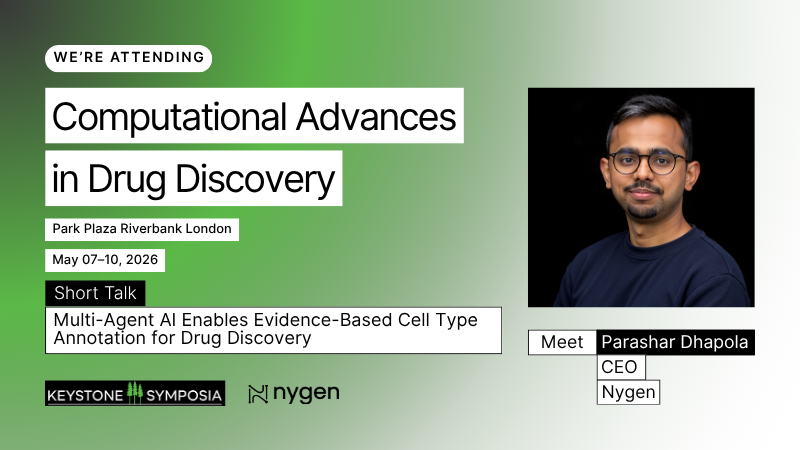
Keystone Symposia: Computational Advances in Drug Discovery 2026
Nygen at Keystone Symposia Computational Advances in Drug Discovery in London, May 7 to 10, 2026. Short talk by Parashar Dhapola on multi-agent AI for evidence-based cell type annotation.
Conference overview
Keystone Symposia: Computational Advances in Drug Discovery brings together leaders in computational chemistry, AI for drug design, multi-omics, and translational science. The programme runs across four days and covers structure-based small molecule design, protein therapeutic design, AI-based acceleration of multi-omics, predictive toxicology, and translational and global health applications.
Dates: May 7 to 10, 2026, with departure on May 11.
Venue
Park Plaza Riverbank London
18 Albert Embankment, London SE1 7TJ, United Kingdom
Travel, lodging, and venue details are published on the Keystone Symposia meeting page.
Nygen at Keystone
Parashar Dhapola, PhD, will be attending and presenting a short talk in the session on AI-based acceleration of multi-omics advances in cell biology.
Short talk by Parashar Dhapola - Nygen
Title: Multi-Agent AI Enables Evidence-Based Cell Type Annotation for Drug Discovery
Session: AI-based Acceleration of Multi-Omics Advances in Cell Biology
Date and time: Saturday, May 9, 2026, within the 8:30 to 11:00 AM BST session.
Room: Ballroom 1, Park Plaza Riverbank London.
Cell type and cell state identification from single-cell data is a foundational step for target discovery and translational biology, and it needs both reproducibility and adaptability to biological heterogeneity. Machine learning tools give reproducibility; large language models promise contextual adaptability. Agentic AI is useful for exploratory analysis but in our experience introduces unacceptable variance for recurring annotation at scale. To address this, we designed a structured multi-agent AI workflow that orchestrates models through a scientific process of hypothesis generation, elimination, and evidence gathering. Benchmarks from our recent preprint showed accuracy improvements of 388% over GPTCellType, 268% over CellTypist, and 101% over SingleR, validated across 977 clusters and 20 datasets. The workflow is built to largely eliminate hallucination and cherry-picking, and has since been applied to annotation workloads at production scale. It is now in validation with pharma partners across oncology tumor microenvironment mapping and autoimmune tissue atlases. This short talk shares the framework, results, and where structured AI workflows outperform agentic approaches in drug discovery.
Session agenda
AI-based Acceleration of Multi-Omics Advances in Cell Biology
Saturday, May 9, 2026, 8:30 to 11:00 AM, Ballroom 1
- Daniel J. Anderson, Integrated Biosciences. Fully AI-native Small Molecule Drug Discovery Based on Complex Cellular Phenotypic Models
- Alexander Hillisch, UCB BioSciences GmbH. Holistic De Novo Drug Design at UCB
- Ben Lehner, Wellcome Sanger Institute. Complete Allosteric Maps for Drug Discovery
- Parashar Dhapola, Nygen Analytics AB. Short Talk: Multi-Agent AI Enables Evidence-Based Cell Type Annotation for Drug Discovery
- Alyssa Rosenbloom, Nomic Bio. Short Talk: Large-Scale Proteomics for AI/ML Applications: Insights from Quantifying 1,000 Proteins in 20,000 Samples
Meet our team
If you are attending Keystone and want to continue the conversation beyond the short talk, Parashar is available for meetings across the conference. Reach out via LinkedIn or email parashar.dhapola@nygen.io to find a time.
Registration
Registration, abstract submissions, and the full programme are on the official Keystone Symposia page.
