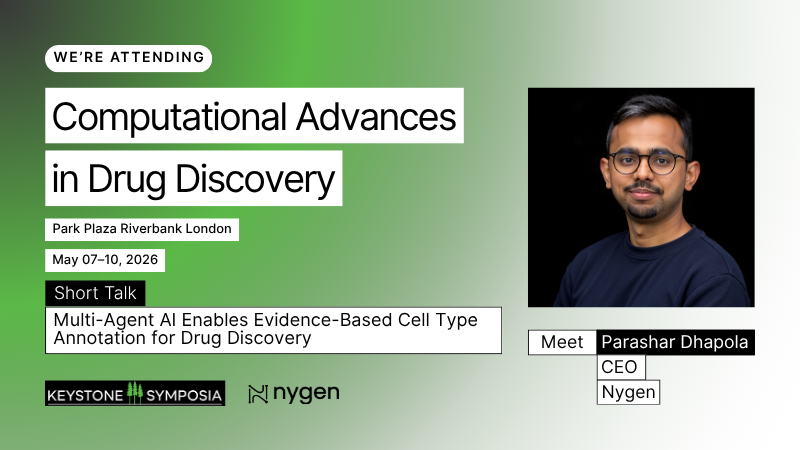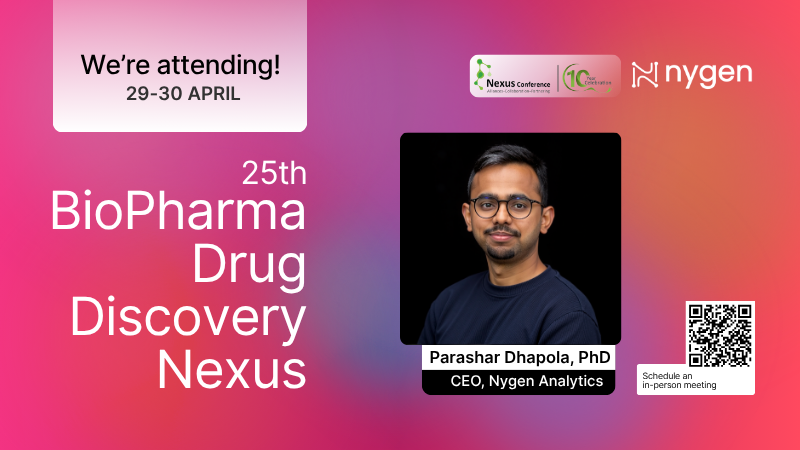
25th BioPharma Drug Discovery Nexus 2026, Zurich
Nygen at the 25th BioPharma Drug Discovery Nexus in Zurich, April 29–30, 2026. Session with Parashar Dhapola on AI agents versus AI workflows for single-cell annotation at scale.
Read more →A curated index of articles, updates, events, and published work across single-cell research.
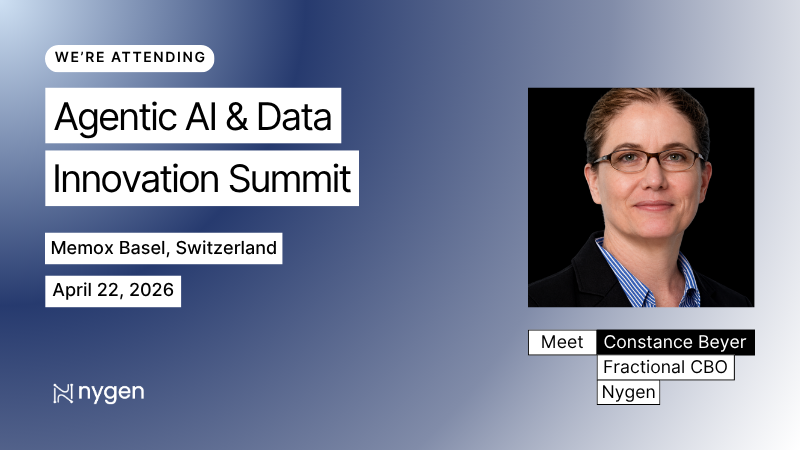
Nygen at the 25th BioPharma Drug Discovery Nexus in Zurich, April 29–30, 2026. Session with Parashar Dhapola on AI agents versus AI workflows for single-cell annotation at scale.
Read more →
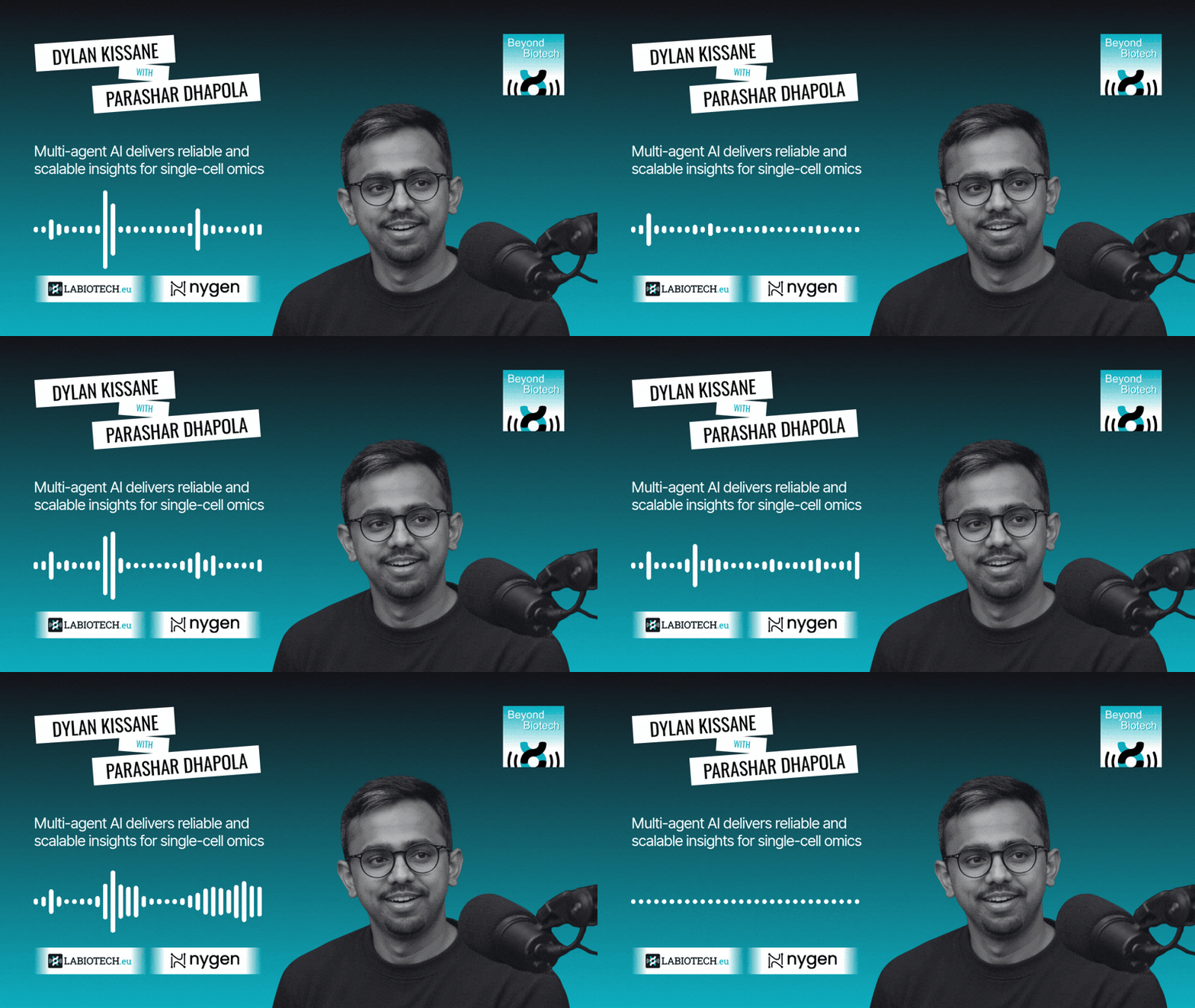
Parashar and Dylan discusses where AI truly delivers in biopharma, the persistent gaps in exploratory data analytics, and the critical bottlenecks in single-cell annotation. In a world abounding in AI hype, Parashar helps us cut through the noise and point out paths to data driven success.
Listen →
Why we rebuilt CyteType as a deterministic AI workflow instead of an agent, and why that distinction matters for production cell annotation pipelines.
Read more →
Running CyteType's AI agents across thousands of single-cell RNA-seq datasets in production exposed run-to-run variance, selective evidence gathering, and inconsistent depth. We rebuilt cell type annotation as a deterministic LLM workflow for reproducible, auditable results in drug discovery pipelines.
Read more →
A free, hands-on single-cell RNA-seq and multi-omics course. Learn to go from raw data to biologically interpretable results in under 3 hours using ScarfWeb.
View course →
Discover how multi-omics integration is reshaping drug discovery by uncovering disease mechanisms, prioritizing drug targets, and connecting genomics, epigenomics, transcriptomics, proteomics, and metabolomics into a usable biological model.
Read more →
An updated guide to the most useful public single-cell RNA-seq databases in 2026, including archives, atlas portals, and domain-specific resources for data discovery and reuse.
Read more →Fireside chat with Parashar Dhapola on building Nygen and how CyteType uses multi-agent AI for evidence-grounded cell annotation. Hosted by BIOTECH XYZ.
Read more →Deep learning and agentic AI analysis of single-cell RNAseq data.
Read more →
Veronique Brault uses single-cell RNA-seq to study how DYRK1A gene dosage affects striatal development in Down syndrome and intellectual disability mouse models.
Read more →
Ram Krishna Thakur, Göran Karlsson explore how single-cell omics reveals cellular heterogeneity driving clinical outcomes in CML.
Read paper →
CyteType uses a five-agent AI framework for accurate cell type annotation in scRNA-seq data. Outperforms reference-based methods by 300%+ in benchmarking.
Read more →Explore why LLMs alone fail at cell annotation and how CyteType fixed it.
Read more →
Nygen Analytics wins 1M SEK Vinnova grant to develop AI-powered predictive models for cancer immunotherapy with VLP Therapeutics, advancing personalized treatment selection.
Read more →
Inside the Institute of Bioorganic Chemistry Polish Academy of Sciences, a state-of-the-art laboratory charts an ambitious course for single-cell analysis in Poland.
Read more →Hands-on single-cell RNA-Seq and multi-omics analysis course at IBCH Poznan.
Read more →Accelerated single-cell data analysis course with LMU Klinikum.
Read more →Hands-on single-cell data analysis course at University of St. Andrews.
Read more →Hands-on single-cell data analysis course at King's College London.
Read more →
CyteType is multi-agentic annotation system designed for single-cell RNA-seq cluster annotation. Designed to deploy three specialized AI agents to provide accurate cell type identification, literature validation, and pathway-level reasoning beyond traditional marker-based methods and beyond. Built for researchers seeking precise, evidence-backed single-cell data analysis with comprehensive biological context.
Read more →
An year-old facility is quietly revolutionizing how core services support cutting-edge research. Through a partnership built on scientific curiosity and shared problem-solving,
Read more →Accelerated single-cell data analysis course with Max-Planck-Institut.
Read more →
Discover how Porto's i3S bioinformatics core facility is democratizing single-cell analysis for researchers across cancer, neurobiology, and infectious disease studies.
Read more →Hands-on single-cell RNA-Seq and multi-omics analysis course at i3S Porto.
Read more →
Meet Aleksandra Wcislo, the sole operator of BBSRC's Single Cell Sequencing Platform at St Andrews. Discover how one scientist manages everything from bat genomes to placental cells, proving that excellence in genomics doesn't require a large team.
Read more →Accelerated single-cell data analysis course with IGBMC.
Read more →
Discover how spatial transcriptomics and single-cell RNA-seq complement each other to drive next-generation biological insights. Learn about emerging platforms, multi-omics integration, and how Nygen Analytics empowers researchers to leverage both technologies.
Read more →
Discover how integrating spatial transcriptomics with scRNA-seq data enhances biological insights by mapping gene expression to tissue architecture. Learn key integration methods and real-world applications.
Read more →Accelerated single-cell data analysis course with UCM Madrid.
Read more →
In sunny Alicante, two specialists have built an impressive Omics Core Facility that rivals larger institutions. We sat down with Antonio and José to understand their science, approach to experiment design and collaborative methods drives breakthrough research with a lean, efficient operation.
Read more →
Nygen Analytics, the only single-cell–focused omics data-analytics platform to pair ISO 27001 certification and SOC 2 compliance with full GDPR alignment
Read more →
Discover when single-cell RNA sequencing is sufficient for your research needs. This guide explains ideal use cases, analysis techniques, and practical implementations for leveraging scRNA-seq data effectively.
Read more →
Learn how to identify marker genes in single-cell RNA-seq data without coding using Nygen's intuitive platform. This step-by-step guide covers data upload, quality control, clustering, marker detection, and dynamic analysis with detailed screenshots and expert tips.
Read more →Hands-on single-cell data analysis course at UMH Alicante.
Read more →
Uncover the essentials of marker gene identification in single-cell RNA sequencing. This article covers no-code solutions, methodologies, and case studies across various fields.
Read more →Accelerated single-cell data analysis course with Medical University of Graz.
Read more →
Learn the essentials of designing robust single-cell RNA-seq experiments with our practical guide for wet-lab scientists. Covers sample preparation, controls, sequencing parameters, and analysis approaches—including how no-code platforms eliminate computational barriers.
Read more →
Explore how ASI transforms drug discovery by harnessing domain-specific models and advanced computing tools for faster, smarter biomedical innovation.
Read more →
A practical guide to scRNA-seq cluster annotation in 2026, covering marker gene inspection, reference atlas mapping, supervised classification tools, and strategies for resolving ambiguous or disease-associated populations.
Read more →
Uncover the top single-cell RNA sequencing (scRNA-seq) and multi-omics data analytics tools of 2025. This comprehensive guide reviews 8 platforms to facilitate data analysis and reveal cellular insights.
Read more →
Momoko Ishikawa et al. show IL-12-expressing alphavirus particles reprogram tumor immune cells to induce anti-tumor responses.
Read paper →
Gautam Ahuja et al. demonstrate how multi-agent AI systems enable evidence-based cell annotation in scRNA-seq data.
Read paper →
Sara Palo et al. reveal how chromatin accessibility patterns shape lineage plasticity during blood cell development.
Read paper →
Pavan Prabhala et al. map the transcriptional landscape of human airway epithelium, identifying HLF as a key regulator.
Read paper →
Discover how building cell atlases parallels Google Maps - transforming scattered cellular data into integrated, navigable maps for drug discovery.
Read more →
A practical guide to batch effect correction and normalization in scRNA-seq data, covering when integration is justified, leading tools including Harmony, Seurat, BBKNN, and scVI, evaluation strategies, and how to avoid overcorrection.
Read more →
Discover solutions to bridge bioinformatics skill gaps in single-cell research, enabling easier scRNA-seq analysis for wet-lab scientists.
Read more →
Discover single-cell transcriptomics, a transformative technique for analyzing gene expression at the cellular level in biology and medicine.
Read more →
Explore key challenges and advanced strategies in scRNA-seq data analysis for both new and experienced researchers.
Read more →
Daniel Zucha et al. map glial cell responses over time in a mouse brain ischemia model using spatial transcriptomics.
Read paper →Ivan Imaz-Rosshandler et al. predict and validate cell differentiation trajectories during early mammalian organogenesis.
Read paper →
Sijie Li et al. introduce EpiCarousel for efficient metacell identification in large-scale chromatin accessibility datasets.
Read paper →
Radek Sindelka et al. characterize cells that initiate regeneration during Xenopus tail regrowth.
Read paper →
Liang Wang et al. present CTEC, an ensemble clustering method for robust scRNA-seq data analysis.
Read paper →
Rebecca Warfvinge et al. link single-cell multi-omics heterogeneity in CML to variations in therapy response.
Read paper →
Sagnik Yarlagadda and Todd D. Giorgio provide a practical guide to scRNA-seq analysis using web-based platforms.
Read paper →
Mikael N. E. Sommarin et al. define developmental-specific populations in human fetal blood formation using multi-omics.
Read paper →
Parashar Dhapola et al. introduce Scarf for memory-efficient single-cell sequencing analysis, published in Nature Communications.
Read paper →