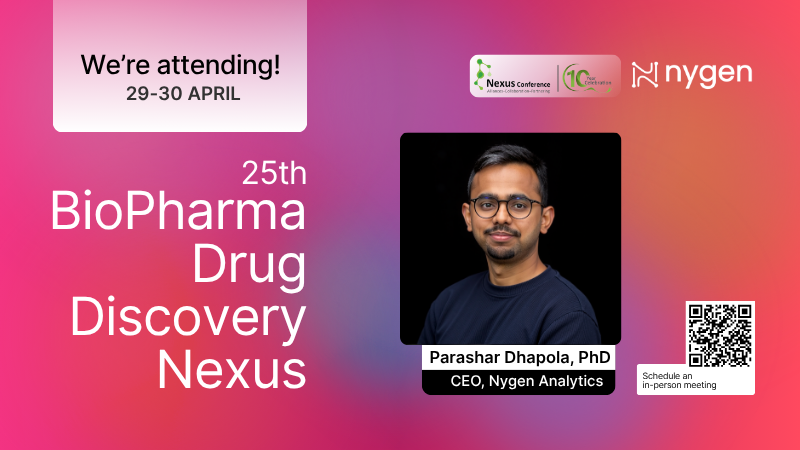
25th BioPharma Drug Discovery Nexus 2026, Zurich
Nygen at the 25th BioPharma Drug Discovery Nexus in Zurich, April 29–30, 2026. Session with Parashar Dhapola on AI agents versus AI workflows for single-cell annotation at scale.
Conference overview
The BioPharma Drug Discovery Nexus is an invitation-only forum for senior discovery scientists, R&D leaders, and industry pioneers, together with technology partners shaping drug discovery. The agenda spans target identification, lead optimization, translational research, and emerging discovery platforms, including AI, omics, and computational discovery.
Dates: April 29 and 30, 2026. The published programme runs from registration through closing remarks on each day (see the schedule). Parashar Dhapola’s session is on April 29 (details below).
Venue
Radisson Blu Hotel, Zurich Airport
Rondellstrasse, 8058 Zurich, Switzerland
Wi-Fi and on-site parking are available at the venue. Hotel booking information is published on the conference website.
Nygen at Nexus
Parashar Dhapola, PhD, is listed among the industry leaders at this edition. Nygen is also a partner at the event alongside other discovery-focused organizations.
Hear from Parashar Dhapola - Nygen
Title: AI Agents vs. AI Workflows: Lessons from Annotating Single-Cell Data at Scale
Session time: April 29, 2026, 11:45–12:05 CEST (20 minutes)
Cell type and cell state identification from single-cell data demands both reproducibility and adaptability to biological heterogeneity. Machine learning tools provide reproducibility; AI methods promise contextual adaptability. Agentic AI offers flexibility for exploratory analysis, but our experience shows it introduces unacceptable variance when applied to recurring annotation at scale. To address this, we designed a structured AI workflow that orchestrates models through a scientific process of hypothesis generation, elimination, and evidence gathering. Benchmarks from our recent preprint showed accuracy improvements of 388% over GPTCellType, 268% over CellTypist, and 101% over SingleR, validated across 977 clusters and 20 datasets. The workflow is built to largely eliminate hallucination and cherry-picking at scale and has since been applied to annotation workloads at production scale. It is now in validation with pharma partners across oncology tumor microenvironment mapping and autoimmune tissue atlases. In this talk, we share a practical framework for deciding where structured AI workflows outperform agentic approaches and where agents remain the better fit.
Registration
Use the conference website and registration for delegate passes, schedules, and brochure downloads.
