DYRK1A & Striatal Development: A Single-Cell Analysis Journey

From bench to insight | Researcher Stories in Single-Cell Analysis
Bench to Insight is a series featuring researchers using single-cell analysis to answer biological questions that matter to them. Each article focuses on the science, the challenges, and the decisions that shape a project. No two journeys look the same. We start with Veronique Brault.
From Structural Biology to Neurodevelopment
Veronique Brault didn't set out to study intellectual disability. Her PhD at a structural biology lab in Switzerland focused on actin isoforms in Drosophila, specifically how nearly identical proteins could perform distinct functions in different tissues. "We used transgenic constructs to express different actin isoforms in place of the native one to see if they could rescue the phenotype," she explains. "That was my PhD."
The pivot toward vertebrate neurodevelopment came during her postdoc in Germany, where she studied how Wnt and beta-catenin signaling influence early neural patterning in mouse embryos. When she later joined CNRS in France, she landed in a lab generating segmental trisomy mouse models to study Down syndrome.
That's where she encountered DYRK1A.
The Dosage Paradox
The gene presents a paradox. Overexpression, as occurs in trisomy 21, contributes to the cognitive deficits seen in Down syndrome. But haploinsufficiency, where one copy is lost or mutated, causes a separate condition: DYRK1A syndrome, characterized by intellectual disability, distinctive facial features, and often epilepsy. Overexpression or underexpression of the same gene leads to neurodevelopmental impairment.
"That duality became the core of my research focus," Brault says. She wanted to understand how DYRK1A affects different neural cell populations during development, and why dosage matters so much.
Her lab created conditional knockout models, selectively deleting DYRK1A in either glutamatergic or GABAergic neurons. When they combined these with trisomic models, the results were striking: rescuing DYRK1A dosage in GABAergic neurons had a much more significant effect than doing so in glutamatergic neurons. The same held true in haploinsufficiency models. Deleting one copy of DYRK1A in GABAergic neurons alone was enough to recapitulate many key features of the human syndrome.
"That led us to focus deeply on GABAergic development," Brault says. "And more recently, on how DYRK1A impacts striatal neurogenesis."
Into the Striatum
The striatum wasn't an obvious target. Most intellectual disability research focuses on the cortex or hippocampus. But in Brault's models, the striatal phenotype was the most consistent and penetrant. Haploinsufficient mice showed reduced striatal volume, enlarged ventricles, memory deficits, and epilepsy-like behavior.
When she generated a conditional homozygous knockout in GABAergic progenitors, the phenotype was catastrophic. Pups were born but died shortly after, showing dyskinesia, shaking, and abnormal postures. Their striatum was nearly absent.
"I wanted to understand why," Brault says. "Was this a problem of proliferation, differentiation, or cell death?"
The answer was apoptosis. DYRK1A normally phosphorylates caspase-9, promoting cell survival. Without the kinase, that phosphorylation is reduced, and the intrinsic apoptotic pathway activates. Brault confirmed this with Western blots and cleaved caspase-3 staining.
But she wanted more resolution. What populations were being affected? Were there molecular shifts occurring before the apoptosis became visible?
Single-Cell Sequencing at E16.5
Brault performed single-cell RNA sequencing on E16.5 embryonic brains from both control and heterozygous conditional knockout animals. E16.5 corresponds to the late phase of striatal neurogenesis, when early-born striatal neurons have already migrated to the prospective striatum. She chose the heterozygous model because it reflects human DYRK1A syndrome, and the relatively late timepoint offered a window to see whether the gene was affecting particular neuronal subpopulations.
The homozygous model wasn't an option for single-cell work. Too many GABAergic cells were already in apoptosis and wouldn't be captured in sequencing.
The results were humbling. "At the cell population level, I didn't see major differences," she says. "The knockout and wild-type samples overlapped quite well in UMAP space."
This is a common challenge in developmental single-cell work. Unlike adult tissue, where neurons, astrocytes, and oligodendrocytes form discrete clusters, embryonic cells exist along gradients of differentiation. Identities are fluid. Clean clusters are rare.
"Most of the cells are in transition," Brault explains. "They're progenitors, intermediate precursors, or immature neurons. So the UMAP space is more of a continuum than a set of clean clusters."
Still, differential expression analysis across progenitor and immature neuron clusters revealed a consistent signal: overexpression of genes involved in cell cycle regulation and DNA damage checkpoints, including p53-related genes. That aligned with what Brault observed in full knockouts. Even in the heterozygous model, stress response programs seem active, albeit subtly.
Finding Direction in Complex Data
When Brault first approached her single-cell data, she didn't have a dedicated bioinformatician. Her institute's GenomEast Platform provides bioinformatics support, but those analysts aren't assigned exclusively to any one project.
"With Nygen, I can explore my data faster without depending on the availability of the bioinformatician," she says.
She appreciated being able to upload AnnData files and quickly check expression levels, cell types, and markers without writing scripts. "I could get a visual sense of what's going on," she says. "It helped me decide where to dig deeper."
But she also encountered limitations. Embryonic tissue doesn't map cleanly onto existing reference atlases. Cell identities at E16.5 don't match adult datasets. "I usually don't rely too much on automatic annotation," she says. "I prefer to annotate manually based on known markers."
Her other request: better tools for comparing conditions along developmental trajectories. "Sometimes the difference is not in the presence or absence of a cell type, but in how fast or slow it differentiates. That's the kind of thing I'm trying to capture."
Connecting Layers
Brault's current focus is connecting transcriptional programs to functional outcomes. Her team has behavioral data, structural phenotypes, and now emerging molecular signatures. The challenge is integrating these layers.
"I want to show that, for example, a delay in striatal GABAergic differentiation leads to specific motor or cognitive impairments," she says.
She's planning spatial transcriptomics experiments at E14-E16, hoping to map where exactly these shifts occur within the developing brain. It's one thing to see a difference in gene expression; it's another to see it mapped onto anatomical space.
"We're a small team, and we don't have in-house bioinformatics," Brault says. "So working with people who can help build integrated models would really help us push the research forward."
For now, she continues combining single-cell data with other readouts: histology, Western blots, behavioral phenotyping. She doesn't want to draw too much from any single modality, but rather use them together to build a bigger picture.
"Even if the single-cell data doesn't give all the answers, it supports the broader model we're working with: that DYRK1A affects survival, differentiation, and circuit formation, especially in GABAergic populations."
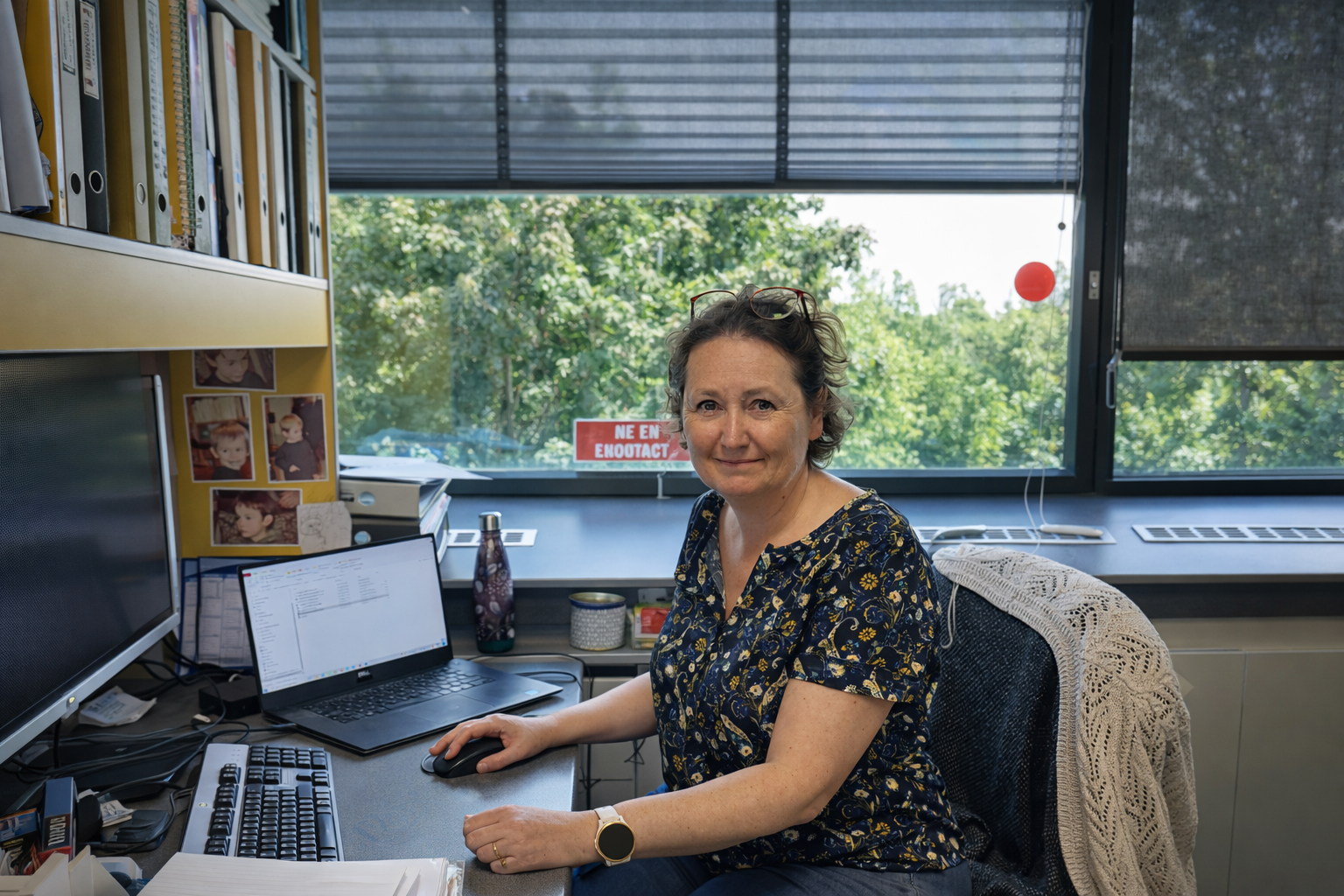
Veronique Brault is a Chargee de Recherche at IGBMC (Institut de Genetique et de Biologie Moleculaire et Cellulaire) in Strasbourg, France.
Note: The mention of specific instruments, technologies, or commercial products (including Illumina, 10x Genomics Chromium, etc.) in this article is for informational purposes only and does not constitute an endorsement by Nygen Analytics AB. All trademarks are the property of their respective owners.
