AGI seems far, but ASI is already here?
Explore how ASI transforms drug discovery by harnessing domain-specific models and advanced computing tools for faster, smarter biomedical innovation.

Traditional drug discovery is notoriously time‐consuming and expensive. With development timelines typically spanning five to ten years and costs reaching billions of dollars, the industry faces a high attrition rate up to 90% of candidates fail in clinical trials. ASI models offer a solution by reducing reliance on laborious trial‐and‐error methods. They streamline early-stage candidate identification and optimization, potentially cutting development timelines significantly. Improved early-stage success rates could unlock substantial financial opportunities while delivering more effective, personalized treatments. In single-cell analysis, ASI is poised to drive even more granular insights into cellular behavior, aiding in the identification of rare cell types and predicting cell state transitions crucial for precision medicine.
Real-World Impact: Case Studies and Success Stories
Several innovative companies are already harnessing ASI to revolutionize drug discovery:
- ARC Institute Evo2 leverages evolutionary algorithms combined with deep learning to simulate complex biological processes. Evo2 is trained on over 9.3 trillion nucleotides from more than 128,000 genomes across the three domains of life, including metagenomic and single-cell data. Its architecture enables rapid identification of genetic mutations and the design of novel genomes, offering significant potential to accelerate drug discovery and biological research.
- Noetik employs its OCTO foundation models to simulate tumor-immune interactions and generate virtual cell simulations for precision immunotherapy. In addition to handling bulk spatial omics data, advanced ASI approaches are now being applied to single-cell datasets to capture cellular heterogeneity within tumors, providing deeper insights into cell-specific responses.
- Formation Bio integrates large language models (LLMs) and AI agents into a comprehensive drug development platform, automating processes from trial design to toxicity prediction. Their platform’s modular design is beginning to incorporate single-cell analysis, which can refine candidate selection by identifying cell-specific biomarkers and therapeutic targets.
- GenBio AI has introduced its AI-Driven Digital Organism (AIDO), a suite of multiscale models that simulate biological processes from the molecular to the systemic level. This includes emerging capabilities in single-cell analysis that enable researchers to conduct high-resolution in silico experiments, revealing novel insights into cellular interactions and state transitions.
- Bioptimus has developed H-optimus-0, an open-source AI foundation model for pathology built using a Vision Transformer architecture. While its current focus is on high-resolution imaging for diagnostic purposes, future enhancements are expected to integrate single-cell imaging data, thereby improving the resolution of cellular-level analyses.
These examples highlight how companies are leveraging ASI not only to accelerate candidate identification, optimize molecular designs, and improve diagnostic precision but also to enhance single-cell analytics, a critical component for understanding complex cellular ecosystems in disease. The below table shows a comparative analysis of architecture of the above examples along with key strengths and challenges.
Navigating Regulatory and Ethical Considerations
Regulatory and ethical oversight is an essential aspect of drug discovery, even if many ASI innovators have not publicly detailed their internal strategies. Regulatory bodies such as the FDA are actively developing guidelines to ensure that AI-driven methods meet rigorous standards for safety, efficacy, and transparency. While companies like Noetik, Formation Bio, GenBio AI, Bioptimus, and ARC Institute have not published comprehensive regulatory or ethical strategies, they are expected to adhere to industry-wide requirements. This mandate extends to single-cell applications, where data quality and reproducibility are particularly critical.
Potential Limitations and Risks
While ASI holds transformative potential, it is not without challenges. High computational demands, data biases, and issues with model interpretability, the so-called "black box" problem, can impact predictive accuracy and clinical trust. In single-cell analysis, challenges include managing the vast data generated by single-cell sequencing and ensuring rare cell populations are accurately captured without bias. Balancing innovation with robust validation and transparent methodologies is essential for regulatory acceptance and ongoing progress.
Future Projections: What Lies Ahead for ASI
Over the next 5–10 years, emerging technologies such as quantum computing may further enhance the capabilities of ASI models. We can expect these systems to evolve into increasingly autonomous platforms that not only design novel drug candidates but also predict patient-specific responses with high accuracy. In the single-cell space, advanced ASI will drive the creation of comprehensive cellular atlases that can map dynamic cell state transitions in real time, revolutionizing our understanding of disease mechanisms at a granular level. As ASI matures, it could reduce drug discovery timelines from years to months or even weeks ushering in a new era where computational design becomes an integral part of pharmaceutical research.
Voices from the Field
Leading experts consistently underscore the transformative impact of ASI in drug discovery. For instance, Demis Hassabis of DeepMind has repeatedly emphasized that while AGI remains a distant goal, targeted ASI applications are already revolutionizing the field. Industry professionals note that the precision, speed, and cost-efficiency enabled by ASI are setting new benchmarks in pharmaceutical R&D.
From the ARC Institute’s Evo2 project, Patrick Hsu, Arc Institute Co-Founder and Assistant Professor at UC Berkeley, stated, "Evo2 has a generalist understanding of the tree of life that's useful for a multitude of tasks, from predicting disease-causing mutations to designing potential code for artificial life. We’re excited to see what the research community builds on top of these foundation models." Similarly, Brian Hie, co-senior author of the Evo2 preprint and Assistant Professor at Stanford, remarked, "Just as the world has left its imprint on the language of the Internet, evolution has left its imprint on biological sequences. These patterns, refined over millions of years, contain signals about how molecules work and interact."
These expert insights reinforce the view that ASI is not only accelerating traditional drug discovery processes but is also opening new frontiers in understanding cellular and molecular mechanisms.
Related articles
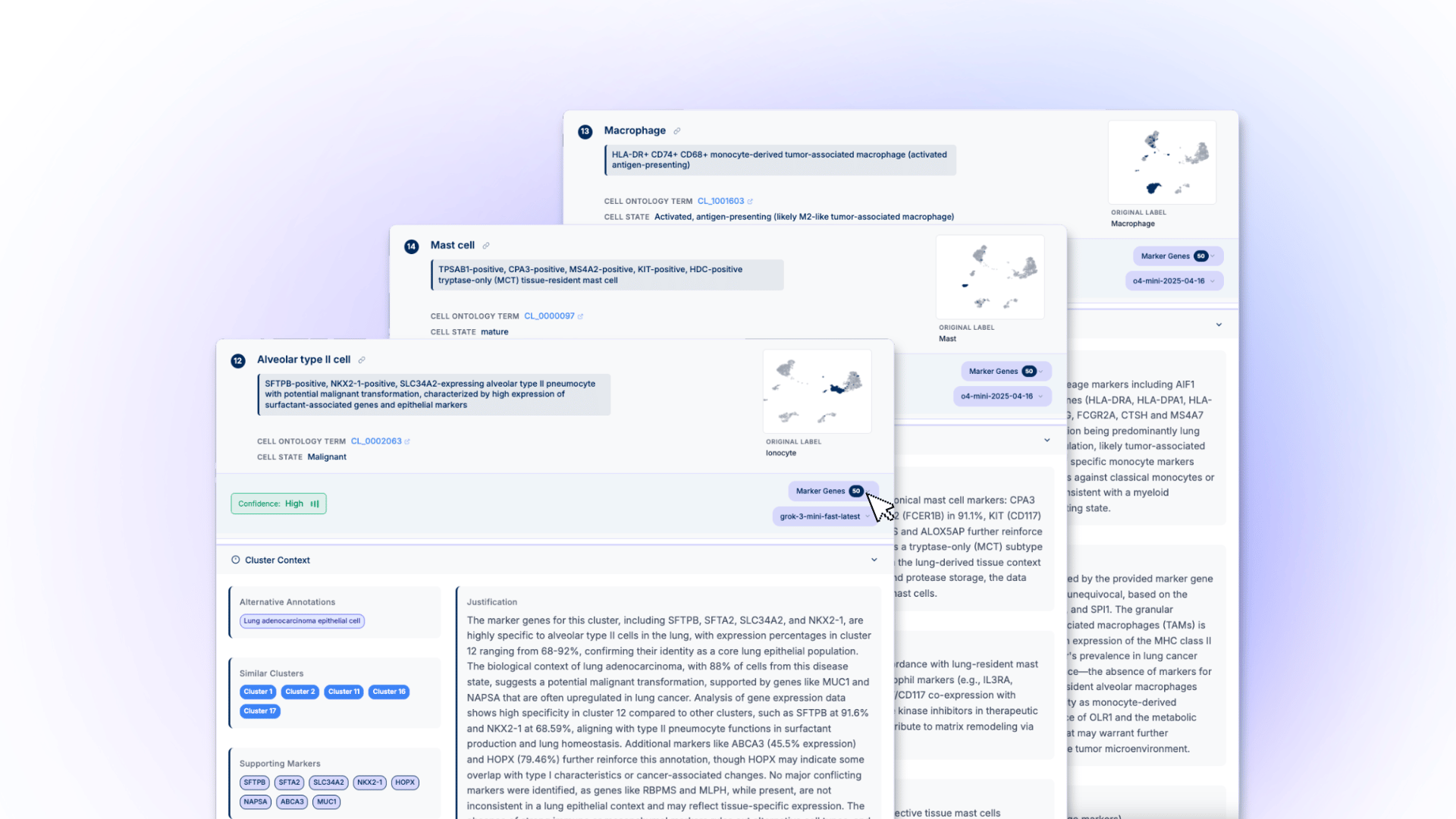
Why We Built AI Agents That Actually Understand Single Cell Data
The original 2025 announcement of CyteType for single-cell RNA-seq cluster annotation. CyteType has since been rebuilt as a structured AI workflow for accurate cell type identification, literature validation, and pathway-level reasoning beyond traditional marker-based methods. Built for researchers seeking precise, evidence-backed single-cell data analysis with comprehensive biological context.
Read more →
The biology in your ligand-receptor analysis, and how to read it
Ligand-receptor analysis is easy to run and easy to over-read. How to get cell-cell communication biology from the ranked table, with LIANA and ScarfWeb.
Read more →
Cherry-picking is a bigger annotation risk than hallucination
Cherry-picking in LLM cell annotation survives reference checks unlike hallucination. Learn why biased marker subsampling is the harder risk and how CyteType prevents it.
Read more →